
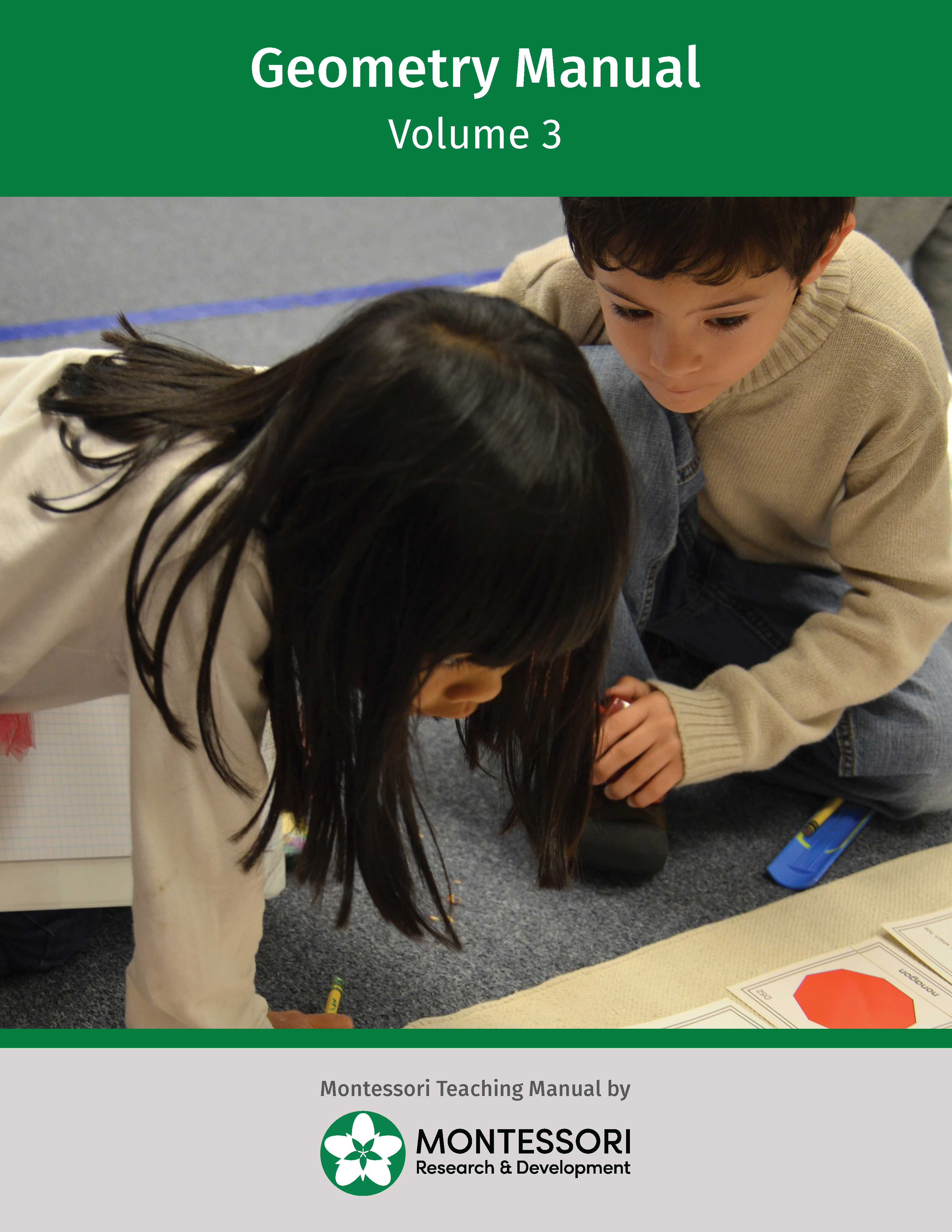
Elementary II · Ages 9–12
Geometry Teaching Manual Vol. 3 - Elementary II (9-12)
SKU: ME.GY3
Product Description
The Geometry Teaching Manual, Volume 3 moves from equivalence to calculation, beginning with area. Using the Yellow Triangles for Area, the Equivalent Figure Material, and the Geometric Cabinet, the child finds the area of many figures: rectangles, parallelograms, triangles, squares, rhombuses, trapezoids, regular and irregular polygons, and the circle. The Tiling Game follows, using cut-out angles to find the sum of the interior angles of triangles, quadrilaterals, and larger polygons. For volume, the child fills the Volume Box with cubes and compares prisms, pyramids, cylinders, and the sphere. Surface area is found by tracing each face of a solid and adding the areas together. The final chapter presents measurement in both the metric and English systems. It covers length, weight, capacity, surface, and volume, as well as converting between units.
What's Included
- Area
- The Tiling Game
- Volume
- Surface Area
- The Metric System
- The English System
Look Inside
Children will develop
- Calculation of area, building on earlier equivalence work
- Computing the area of the circle through the decagon
- Understanding of equivalence among solids
Designed to Work Together
The study of area builds directly on the equivalence insets in Volume 2.
Contents at a Glance
-
Chapter 1
Geometry Classified Nomenclature
Basic concepts, lines, angles, figures, triangles, quadrilaterals, polygons, and circles
-
Chapter 2
Study of Congruence
The Metal Inset Squares and Triangles
-
Chapter 3
Study of Similarities and Equivalence
Proportionality with triangles and rectangles, sensorially and mathematically
-
Chapter 4
The Constructive Triangles
The Triangle Box and the Large and Small Hexagonal Boxes, with equivalences and ratios
-
Chapter 5
Theorem of Pythagoras
Three insets and the construction of the theorem
-
Chapter 6
Equivalence
The Equivalent Figure Material, regular polygons, and the apothem