
Shopping cart

Your cart is empty.

Take a look around.

Early Childhood · Ages 3–6

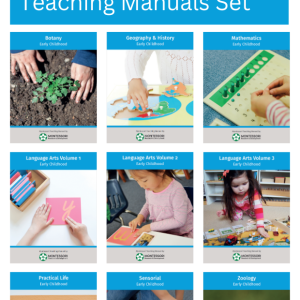
Botany Teaching Manual - Early Childhood

SKU: MP.B

$39.00
  • Expert & research-backed. Trusted for 40+ years.
  • School district purchase method available
  • Delivery time: 3 - 5 business days

Product Description

The Early Childhood Botany Teaching Manual introduces the plant and its six parts: root, stem, leaf, flower, fruit, and seed. Each part is then explored as a specimen in the child's hands, taken apart as a puzzle, and named through simple nomenclature.

For young children, the sensorial experience of a plant comes before its naming. A child needs to look at a leaf, hold it, and turn it over before the word for its parts means anything. Every presentation follows that order. The child explores first, the language follows, and function is demonstrated with the plant itself: colored water climbing a celery stalk, a plant going limp once its roots leave the soil. Nomenclature is presented with three-part cards.

What's Included

  • Living and Non-Living
  • Plant and Animal
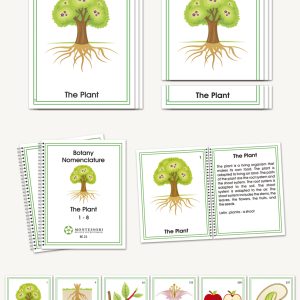
  • The Plant
  • Root
  • Stem
  • Leaf
  • Flower
  • Fruit
  • Seed
  • Compost

Children will develop

  • An appreciation for plants and their parts
  • Vocabulary for the parts, shapes, and venation of plants
  • The powers of observation
  • Visual discrimination
  • Criteria for judging living from non-living, and plant from animal
  • Knowledge of what each part does for the plant
  • Understanding of the fundamental needs of plants

Designed to Work Together

The manual’s nomenclature presentations correspond to the Botany Early Childhood Nomenclature Set.

  • 171 three-part cards
  • Includes labeled pictures, pictures, labels
  • 7 nomenclature booklets

Available in digital subscription

Buy Complete Set:

Content at a Glance

  • Chapter 1

    Living and Non-Living

    Sorting real objects and pictures. Criteria for judging whether something is alive, with movement as the point of interest.

  • Chapter 2

    Plant and Animal

    The same sorting work applied to plants and animals, with nourishment as the distinguishing feature.

  • Chapter 3

    Plant

    Observation of real plants, the fundamental needs of plants, the parts of the plant through puzzle and nomenclature, labeling the classroom for parts of the plant, and sorting vegetables by the part eaten.

  • Chapter 4

    Root

    Parts of the root, shapes of the root, and two demonstrations of what the root does for the plant.

  • Chapter 5

    Stem

    Parts of the stem, the stem as a carrier of nutrients, and the stem as structural support.

  • Chapter 6

    Leaf

    Parts of the leaf, shapes of leaves with the leaf-shape cabinet, and the venation of the leaf.

  • Chapter 7

    Flower

    Parts of the flower, with dissection of a real flower, a puzzle, a worksheet, and nomenclature.

  • Chapter 8

    Fruit

    Parts of the fruit, cut from a real peach, with puzzle and nomenclature.

  • Chapter 9

    Seed

    Parts of the seed, opened from a soaked lima bean, with the tiny plant inside as the point of interest.

  • Chapter 10

    Compost

    Returning plant material to the soil.